A service page content brief: what to give your copywriter
A request to “write a professional service page” leaves a copywriter guessing about the customer, the offer and the facts. A useful brief gives the writer enough evidence to explain the service accurately and enough context to choose what belongs on the page.
You do not need a long brand presentation to begin. Use the short brief below for one service at a time. It suits a small business working locally or across markets, including an Armenian company preparing an English-language website.
Start with the customer’s decision
Describe the person who needs the page and what they are trying to decide. “Anyone who needs our services” is too broad to guide the writing. Name the situation, the problem and the information the customer needs before contacting you.
For a hypothetical equipment-maintenance service, the visitor might need to know whether the company covers their location, works with their equipment and offers the type of visit they need. This is an illustrative example, not a WEBSTART client case. A page for that visitor needs a different emphasis from a page aimed at a purchasing team comparing long-term contracts.
The GOV.UK guide to learning user needs distinguishes evidence from assumptions. Applied to a commercial brief, the practical lesson is to label what customers have actually asked and what the team is only guessing. Do not invent customer research to make the brief look complete.
Define the offer and its boundaries
Write a plain description of what the service includes. Add relevant exclusions, the delivery area, prerequisites and the factors that change the scope. If a quote depends on information from the customer, identify that information rather than asking the writer to invent a starting price.
Separate approved facts from open questions. An unconfirmed delivery time is a question for the service owner, not a gap the copywriter should fill with an attractive promise. Decide who can approve changes to commercial terms.
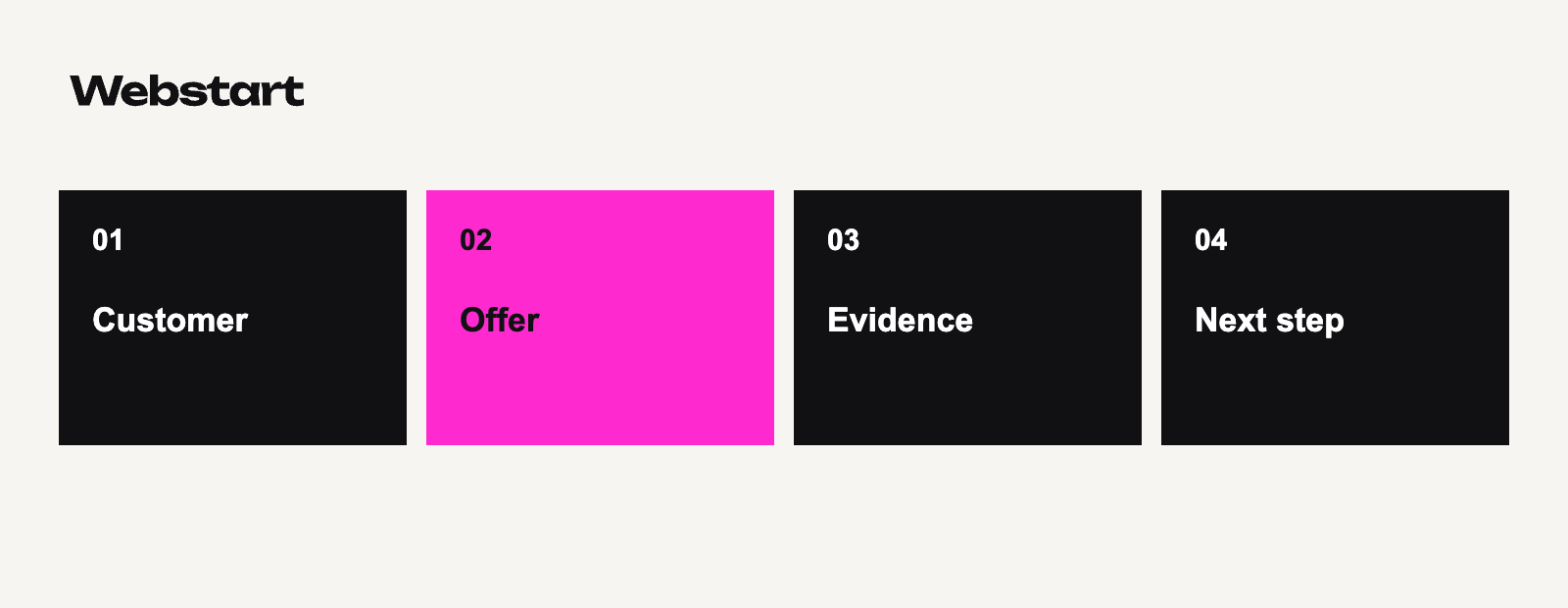
Supply evidence that can be published
Collect the material that supports the page: an authorised project example, a genuine customer question, relevant qualifications, a clear description of the work or approved images. For each item, explain what it demonstrates and whether it may be published.
Keep private client data out of the working brief unless there is a valid reason and an appropriate authorised process for sharing it. A writer usually does not need a client’s personal phone number to understand a service. An example can often be explained without identifying the customer.
Avoid handing over unsupported superlatives and treating them as facts. If the business cannot substantiate “fastest” or “best”, provide a precise description of the service instead. The writer should not turn a testimonial about one project into a claim about every customer.
Choose one meaningful next step
Decide what a suitable customer should do after reading: request a quote, arrange a consultation or ask a specific eligibility question. Explain what happens next and what information the team needs to respond. Do not promise a response time that the team has not agreed to meet.
Ask for a button label and short supporting text that fit that action. The GOV.UK guidance on interface writing recommends clear, direct wording. For a business page, that means a label a customer understands without learning your internal process.
Describe the voice with examples
“Friendly but professional” is a useful starting point, but an example is more actionable. Supply a short approved passage and say what works about it: straightforward explanations, respectful address or clear limits. Also identify wording to avoid, such as inflated promises or unexplained abbreviations.
For a multilingual website, brief each language for its intended reader. Keep the service facts consistent while allowing natural wording and relevant examples. Record who checks each language and who approves the final version. An English page should not be treated as ready just because the menu has been translated.
Copy this short briefing structure
- Service: What are we offering, in plain language?
- Reader: Who is deciding, and in what situation?
- Decision: What should the reader understand before contacting us?
- Scope: What is included, excluded or conditional?
- Evidence: Which facts and materials are approved for publication?
- Questions: What do real customers ask, and what is still unknown?
- Action: What should a suitable customer do, and what happens next?
- Review: Who checks facts, language and the final page?
Leave an item marked “to confirm” when the information is missing. A visible open question is safer and more useful than a polished invented answer.
Review the page against the brief
When the draft arrives, check the offer, evidence and next step before debating individual adjectives. Then read the page on a phone. Check headings, button labels and the enquiry path in context. The brief is successful when it helps the team make those decisions consistently, not when it produces the longest page.
For the next review stage, use our practical service-page audit. If you are planning a new service page or website, contact WEBSTART to discuss the scope.